
The Riviera
Drive down a small side street in midtown Denver and you find this little sign sandwiched between a Home Depot and BMW dealership. The sign’s vintage doesn’t match anything around it. Nor does the neon sign’s style align with the aesthetic of the stucco-coated Mexican restaurant that sits below it. The Riviera sign, however, holds a little secret in this otherwise unremarkable commercial strip. It was one of dozens of swingin’, rowdy bars that lined the streets of Glendale, Colorado. In the 1970s, Glendale was known as “Swingingest square mile in Colorado” and “The richest square mile in Colorado”. At its peak an estimated 50,000 people on JUST a Friday night would cruise into the 1.3 square-mile town to hit up the nearly 40 bars, restaurants and discotheques packed primarily along one street.
Why all the bars?
Present-day Glendale used to be known as “Cowtown” because the many dairies there supplied most of the milk for Denver. As Denver encroached on the community in the mid-20th century, the City of Glendale formed in 1952 to help prevent annexation of the land to Denver.
Throughout the 1950s and 1960s, things began to change for the primarily farming community.
“In 1968, it was difficult to get a liquor license in Denver,” said Elba A. “Buck” Scott, owner of Colorado Mine Co., one of the former Glendale bars. “Then Glendale came along with the same attitude as Aspen.” Hold on sec. Aspen? Really? Things have obviously changed since then, but in the late 1970s Aspen and Glendale had the greatest number of liquor licenses per capita in Colorado, about one license per 90 permanent residents.
Several articles from the time point to many of Glendale’s council members also being landowners in the area as a driver for the bars. With the rise of bars and apartments in Glendale, the value of land climbed from 50 cents to $5 per square foot. The few residents living in the town rarely objected to liquor licenses.
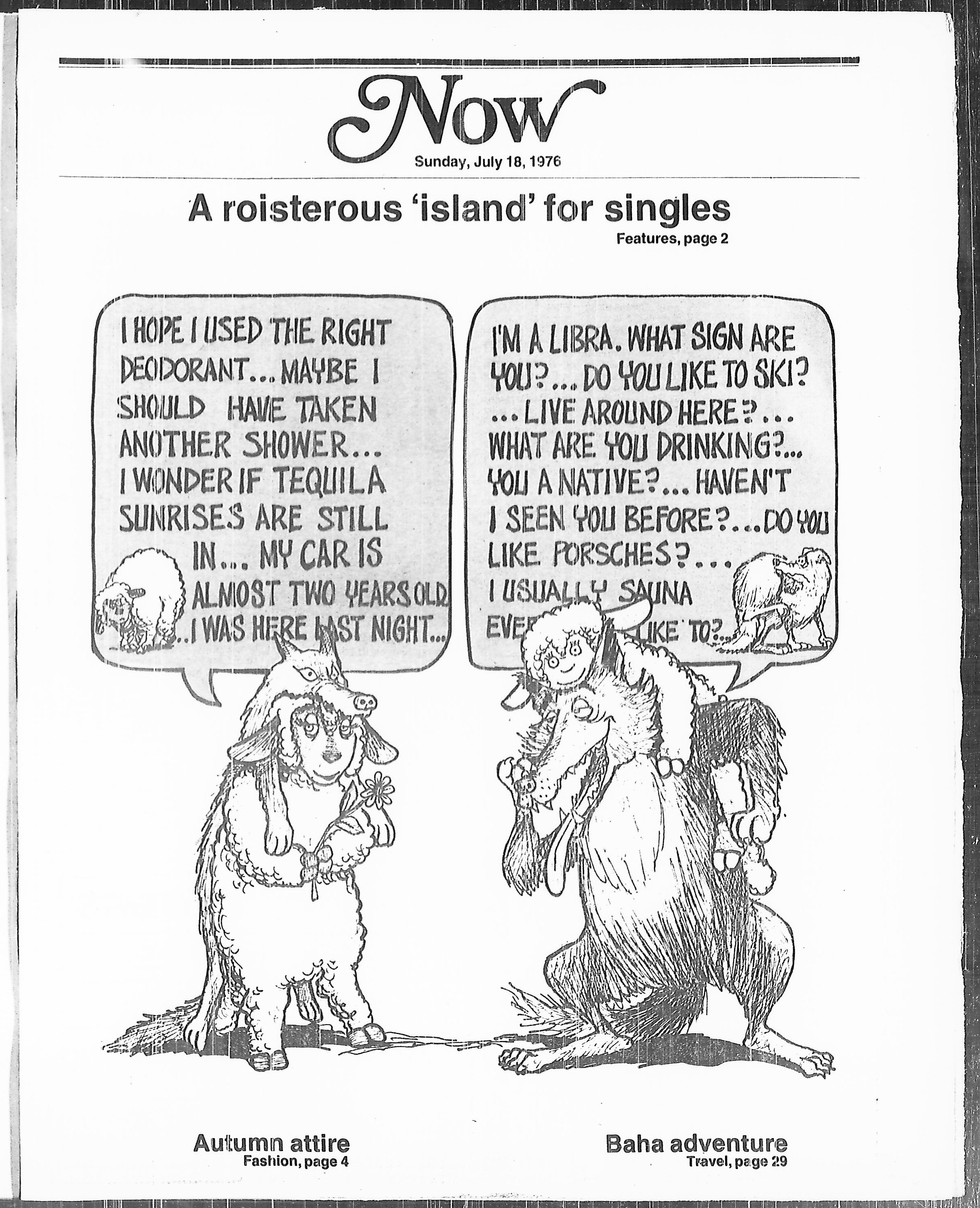
During the 1970s, the daytime population of Glendale was 3,800 with no schools, churches and only 27 single-family homes. In 1975, Glendale paid all its bills in cash. One of the first Targets outside of Minnesota provided 30% of the city’s income, 20% of revenue came from nightclubs, and the rest of the income came from “a multitude of apartment complexes occupied mostly by single persons.” There were more than 3,000 single young people living in Glendale apartments. You can see a cartoon depicting the 1976 dating scene in Glendale from the Rocky Mountain News below.
Rocky Mountain News
Even with the success of the bar scene in Glendale some feared that so many liquor licenses would mean an oversaturation of bars. Many places did go belly up even during the peak. The Glendale City Council also feared that too much competition would push some bars to an “old standby—nude entertainment—to save their business”
“I don’t think [nude entertainment] would get to first base with this Council,” said Glendale’s then-Mayor George T. Garson. “We don’t want any of that gaudy rough stuff.”
“That’s the only thing we don’t want in here,” added Councilman John Johnson, 65. (In 1982 a strip club called Shotgun Willy’s planted itself firmly on one of the most visible corners of Glendale.)
The bars themselves
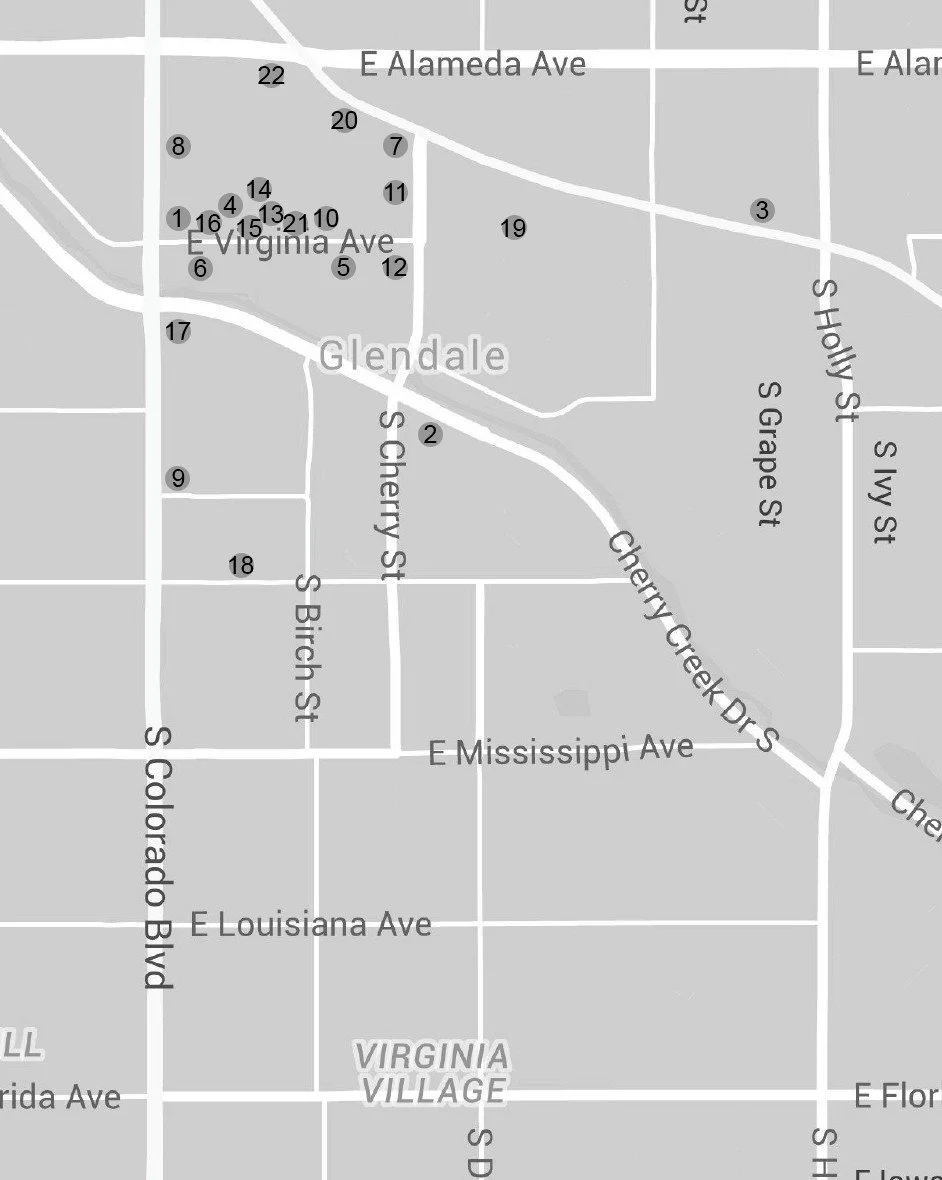
The bars of Glendale had the best names—Club Soda, Urban Cowboy, Mr. G’s, Mr. Lucky’s. I pulled together a rough map of these bars for reference. Some of the locations are lost to time. Several of the buildings still stand along Virginia Avenue to the south as well as east of Target. The only Glendale bar still in business today as its original self is Bull and Bush.
Andy’s Restaurant [490 S. Colorado]
Bull and Bush [4700 E. Cherry Creek]
Chaps
Club Soda [4151 E. Virginia]
Colorado Mine Co. [4490 E. Virginia]
Cork ‘N Cleaver [4042 E. Virginia]
Four-Mile House
Good Life Restaurant [440 S. Colorado]
The Library [800 S. Colorado]
Lift #3 [4501 E. Virginia]
Maxwell’s Restaurant [435 S. Cherry]
Mr. Lucky’s [4550 E. Virginia]
Nantucket Landing [4451 E. Virginia]
Olies
O’Rourkes Cantina [4425 E. Virginia]
Overflow [4111 E. Virginia]
Red Slipper [Now CitySet]
Riviera [Now Las Delicias]
Tommy Wong’s Island Restaurant [4851 E. Virginia]
The Warehouse [4444 S. Leetsdale]
Urban Cowboy
Victoria Station [4330 E. Alameda]
Investors for the bars came from all over Colorado and beyond. Saul Davidson, a famous Denver developer involved in the development of Vail Resorts, financed the start of five nightspots, Mr. Lucky’s, Colorado Mine Co., the Library, Club Gamboo, and the Warehouse.
The Warehouse, located at 4444 Leetsdale Drive, was a frequently mentioned bar during my research. The former barn for milk trucks at Stearns Dairy was converted into 450-seat theater by Peter Rachbach, a then 30-year-old who sought to bring “big name” entertainment to Denver in 1972. Visiting acts included Jerry Lewis, Ray Charles, Little Richard and The Four Tops. Oh, and Fats Domino, Chuck Berry, The Supremes, Olivia Newton-John, and Mel Torme. Great acts and glowing reviews for the entertainment destination could not save the Warehouse from bankruptcy in 1976 when new owners took over the place and renamed it The Complex. Eventually, it was named Lori’s Theater.
Disco also ruled in Glendale. The Lift #3—you can still see the building at 4501 E. Virginia Avenue—opened in 1973 as a disco. More than 2,000 John Travolta look-alikes would flock there on Friday nights. But there was competition in the discotheque world. Sportspage disco opened in March 1974, and the area featured two other discos: Mr. Lucky’s and Nantucket Landing. Some of the newspapers at the time debated the fate of disco and whether it would last. “I don’t know if the disco is dying, but it is certainly in a recession,” said one of the disco owners in a 1977 newspaper article.
Glendale changes it image
Eventually, Glendale sought to clean up its image. A 1994 Rocky Mountain News article credited the changes to “a booming real estate market that values supermarkets over bars, housing laws requiring apartment landlords to accept children and city officials intent on ridding its reputation as a party town.” This included the development of a Cub Foods grocery store where the flagship King Soopers grocery store now sits at Cherry Street and Leetsdale Drive.
Now Glendale seeks to liven up the city again by slowly realizing Glendale 180, but I wonder if it will be attracting 50,000 people again on Friday night.
— HCR