
Cooper Theatre
Many claim that the Cooper Theatre at 960 S. Colorado Blvd. in Glendale, Colorado, was the first purpose-built Cinerama theater in the United States. The circular part of the theatre’s exterior was painted what the designers called bittersweet orange. But, really, I’d call it more fire orange. The exterior of the Cooper Theatre was ablaze in orange, lit up at night as to be visible from Lookout Mountain more than 30 miles away, according to local legend. What is Cinerama? Well, let’s see how the short-lived technology changed they way we view the world through screens.
Cinerama, A Gimmicky and World-Changing Technology
The unveiling of the movie, This is Cinerama, in 1952 was so newsworthy that The New York Times actually put a film review on its front page. Times writer, Bosley Crowther, said: “The new motion-picture projection system known as Cinerama was put on public display for the first time last night before an invited audience at the Broadway Theatre. And, with due account for the novelty of the system, it was evident that the distinguished gathering was as excited and thrilled by the spectacle presented as if it were seeing motion pictures for the first time.”
The audience that night included luminaries such as William Paley, the founder of CBS, David Sarnoff, the head of RCA and NBC, Louis B. Mayer, the former head of MGM, Richard Rodgers, the composer of Oklahoma! and South Pacific, and Tom Dewey, the governor of New York and former presidential candidate. Ed Sullivan, so impressed by Cinerama’s stupendousness, wrote in his Daily News column that it was the biggest thing to hit New York since penicillin.
Why all the fuss? Today, widescreens are the standard, but before This is Cinerama, nearly every movie had been shot and shown in a square format. This is Cinerama began with a conventional squarish screen black-and-white prologue in which Lowell Thomas, a well-known adventurer and radio newscaster, offered a 12-minute talk about the history of the moving image. Finally, Thomas said “Ladies and gentlemen, this is Cinerama!” and the curtains slowly parted to reveal the rest of a huge screen. The film then cut to what has been called the most famous point-of-view shot in history, as the audience got to experience a front-seat ride on a roller coaster.
Though it only played in 14 converted theaters during its initial two-year run in the United States, This Is Cinerama, was the highest-grossing film of 1952, winning over movies like Singin’ in the Rain and The Quiet Man.
The Cinerama process was invented by Fred Waller, a Paramount special-effects technician in the 1920s and 30s—a man also known for inventing water skis. Cinerama was so wide it had to be shot by special three yoked-together cameras and shown by three synchronized projectors. These images filled a curved, panoramic screen that was almost three times as wide as it was tall. The soundtrack was recorded in seven-channel stereo—two-channel stereo recordings wouldn’t become common for another five years.
In an era when audiences were abandoning movie theaters for the novelty of television, the movie industry was desperate—and it turned to many gimmicks such as Cinerama. For example, the 3D craze began two months after This Is Cinerama’s premiere with the release of Bwana Devil. While 3D seems to come and go, Cinerama’s lasting influence is clear. This is Cinerama launched an era of widescreen spectaculars—think Ben-Hur and Star Wars—and eventually the widescreen format we still enjoy today albeit more often on our televisions and smart phones.
The Cooper Theatre, bringing Cinerama to Colorado and beyond
Although many existing theatres were adapted to show Cinerama films, in 1961 and 1962 the non-profit Cooper Foundation of Lincoln, Nebraska, designed and built three near-identical circular "Super-Cinerama" theaters in Denver, St. Louis Park, Minnesota (a Minneapolis suburb), and Omaha, Nebraska. Designed by architect Richard L. Crowther of Denver, a Fellow of the American Institute of Architects. Richard Crowther was an influential Denver architect who worked with companies such as the Lakeside Amusement Park, Joslin’s, Baur’s, Fashion Bar, Fontius Shoes, Berry’s Restaurants, White Spot Restaurants, King Soopers, Fox Theaters and many others. Crowther’s creations were considered the finest venues to view Cinerama films.
The 20,000-square foot Cooper Theatre had 814 seats—150 in the balcony—and parking for 350 cars. Groundbreaking for the theater started on May 17, 1960, with the theater opening in March 1961. Budgeted at $750,000, the theater’s final cost ended up being $1,000,000 primarily due to cost of the Cinerama equipment. The circular theater was 120 feet in diameter with a 146-degree louvered movie screen that 105 feet wide by 38 feet tall. It was not an ordinary screen, but one made up of 2,300 verticals strips of perforated tape, angled like a vertical Venetian blind. This screen setup was to prevent light projected to each end of the screen from reflecting to the opposite end and washing out the image.
The unusual design of a round theater building coupled with the Cinerama format was expected to draw tourists from hundreds of miles away, and ticket offices for the theater were set up in cities throughout Colorado, Wyoming and New Mexico. One of its first ads noted, “Never in a neighborhood theatre – Never on TV!” The theater was meant to be a one-of-kind experience, and its Cinerama movies would play for runs that lasted months.
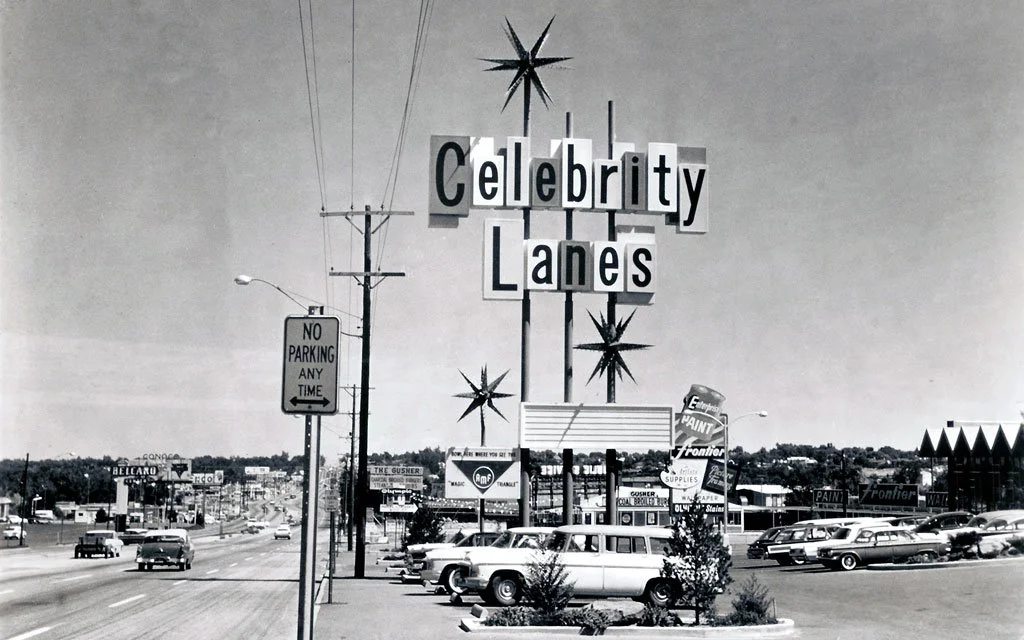
The tourist-minded Cooper Theatre was well-placed along Colorado Boulevard. Its neighbor was Celebrity Sports Center—a 122,600 square-foot center that included attractions such as a 2,000-person bowling alley, a 164-foot wide indoor pool—the largest in Colorado—and 13,500 square feet of slot-car racing tracks. The “celebrity” part of the name came from the fact that its owners included Hollywood celebrities, such as Jack Benny, George Burns, Bing Crosby—and Walt Disney. It, too, was designed to be destination for tourists, and a possible expansion of Walt Disney in-person experiences such as Disneyland. It also had an amazing sign as well:
The World Moves on to What’s Next
Although Cinerama changed the movie going experience, the technology itself wasn’t meant to last. Even the Cooper Theatre moved on from Cinerama within a few years of opening. The theater showed its last Cinerama movie in 1966. Only seven full-length Cinerama movies were ever made.
Cinerama was not cheap to film nor view—for example, the 7-track magnetic soundtrack came with a script to direct the theater sound manager when to manually transfer the audio from one sound channel’s speaker to another on the other side of the theater. Technologies like Twentieth Century Fox’s CinemaScope and Paramount’s VistaVision used single-projector processes provided the widescreen experience that didn’t demand nearly as much from filmmakers or theater owners.
How the West Was Won played for more than a year at the Cooper and grossed over $1,000,000. Due to rising costs, however, this would be the last feature filmed in three-strip Cinerama. The last Cinerama film shown at the Cooper Theatre was The Best of Cinerama with scenes compiled from previous Cinerama films. The Cooper Theatre soon switched to a single-projector format. In 1975, The Cooper Theatre had an additional theater attached to it, The Cooper Cameo. More recent audiences of the theater remember it as one of the few large screens in town to see first-viewing, special engagements of films such as Star Wars, Close Encounters of the Third Kind and Alien.
The Cooper Theatre ultimately became part of United Artists theaters in 1989, accompanied by an off-white exterior paint job. Examining the last photos of the theater, I can imagine how the luster of The Cooper Theatre was lost in this renovation—its famous script removed from theater’s exterior and the dramatic horizontal lines of the lobby covered with a generic maroon façade. The theater was torn down in 1994 to make room for the Barnes and Nobles parking lot. Its neighbor, Celebrity Sports Center, became a Home Depot shopping center.
As for the other “Super-Cinerama” theaters built along with Denver’s Cooper Theatre, the Minneapolis theater last showing was Dances with Wolves in January 1991. Despite attempts to preserve it, the theater was torn down in 1992 and replaced with an office park. The Omaha theater was closed on September 28, 2000, from the bankruptcy of Carmike Cinemas, and was demolished on August 20, 2001.
Despite the demolition of these landmark Cinerama theaters, there are still a few Cinerama theaters in existence, including the Cinerama Dome in Los Angeles and Seattle Cinerama (the latter was saved by Microsoft co-founder, Paul Allen). Although the ability to see the true three-camera Cinerama format is virtually lost for most moviegoers, it is cool to think that how our little slice of Denver was a part of the widescreen transformation.
— HCR